An impact that was due to the Cuban Missile Crisis was the Limited Nuclear Test Ban treaty. The treaty prevented nuclear explosions underwater, in the atmosphere, or in outer space. The treaty allowed underground nuclear tests as long as no radioactivity leaks outside the boundaries of the nation doing the test. The Limited Nuclear Test Ban treaty was signed by Russia in Moscow on August 5, 1963 and the Senate approved the treaty on September 23, 1963, in the U.S. Kennedy signed the treaty on October 7, 1963.
The Cuban Missile Crisis
The Greatest Event of a War that Never Happened
Nuclear Test Ban Treaty
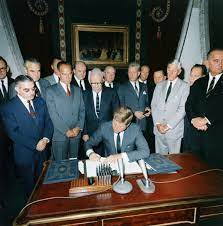
history. Signing of the Nuclear Test-Ban Treaty. (1963) .
The Red Phone
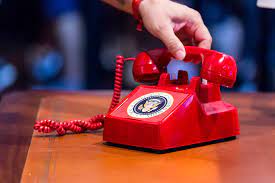
Crawford, N. (n.d.). Cold War Causalities. Boston Review.
The “Red Phone” was created so future misunderstandings wouldn’t happen between America and Russia. This was the first message sent from the Moscow-Washington Hotline, "The quick brown fox jumped over the lazy's dog's back 1234567890." The line connecting the two countries connected Washington and Moscow. The line is still in use if needed today but is rarely needed.
Cuba Faces Isolation
“Perhaps the biggest consequence of the Cuban Missile Crisis on Cuba was the political isolation that the country faced in the years and decades that followed. After the event's conclusion, Cuban relations with the Soviet Union reached an all-time low with the Khrushchev regime. Cuba also faced political isolation from the United States on a scale never before seen, as economic, political, and social ties were effectively severed.” (Slawson) This quote is a good piece of evidence that shows how Cuba was being isolated by the U.S. and Soviet Union. These two countries cut off Cuba because the Soviet Union couldn't use Cuba for anything else and the U.S. didn't like that Cuba was hostile and not respecting of the United States.